
The number of active sellers on eBay ranges from 17 to 18 million, but even though the number of sellers competing for customers has plateaued, their inventories are growing rapidly.
The platform’s native AI tools have played a major role in accelerating the online marketplace, making the listing creation process effortless and enabling businesses to expand their inventories while preserving operational efficiency.
Consequently, driving organic or paid traffic to your store requires implementing best SEO and GEO practices, understanding eBay’s Promoted Listings ecosystem, and a full-fledged social media strategy.
The omni-channel digital marketing approach requires an advanced understanding of eBay’s search algorithms and ranking factors, as well as careful ad spend budget planning and the strategic use of social media to generate additional organic traffic.
Read on to learn more about creating a digital marketing strategy for your eBay store and using it to grow your business.
Key takeaways
- Approximately half of the listings on eBay are promoted through CPC or CPS campaigns.
- 5.2 million active eBay sellers promoted at least one listing via Priority or General Strategy campaigns in Q1 of 2026.
- Over 50% of online shoppers use social media to discover and research products.
- 250 million internal search queries are processed on eBay every month.
- Fully populating the listing’s Item Specifics section boosts its search impressions by 20%.
What does eBay advertising entail?

Digital marketing within a closed marketplace ecosystem, such as eBay, is a strategic process of driving targeted traffic to specific listings or a store using the platform’s tools and external marketing channels.
The visibility of your products in such environments is determined by the platform’s algorithm, which uses a broad range of ranking factors when displaying products in the search results.
So, whether your listing appears in the top results for a specific query depends on how well it is optimized for the search engine.
Additionally, promoting listings through paid campaigns or featuring them in social media posts increases their visibility and click-through rates.
The primary goal of digital marketing on eBay is to ensure that products can reach high-intent buyers.
Still, its benefits include improved customer retention rates, higher conversion rates, and the flywheel effect of higher sales velocity, which signals to eBay’s Cassini algorithm that listings should be granted greater visibility.
Core elements of digital marketing eBay campaigns

Content is the foundation upon which a brand’s digital marketing strategy is built.
In other words, to create an effective marketing strategy that drives sales, eBay sellers must first develop and implement a content creation plan.
So, whether you’re trying to improve your organic search rankings, run CPC or CPS campaigns more effectively, or increase your social media presence, the first step is to produce the visual or textual content that both fits the platform’s technical requirements and sparks the curiosity of eBay users.
So, let’s dive deeper and explore the core elements of successful digital marketing strategies on eBay.
Search engine and generative engine optimization
eBay’s search algorithm is constantly changing, so merchants must frequently adjust their SEO strategies to secure a steady source of traffic for their listings.
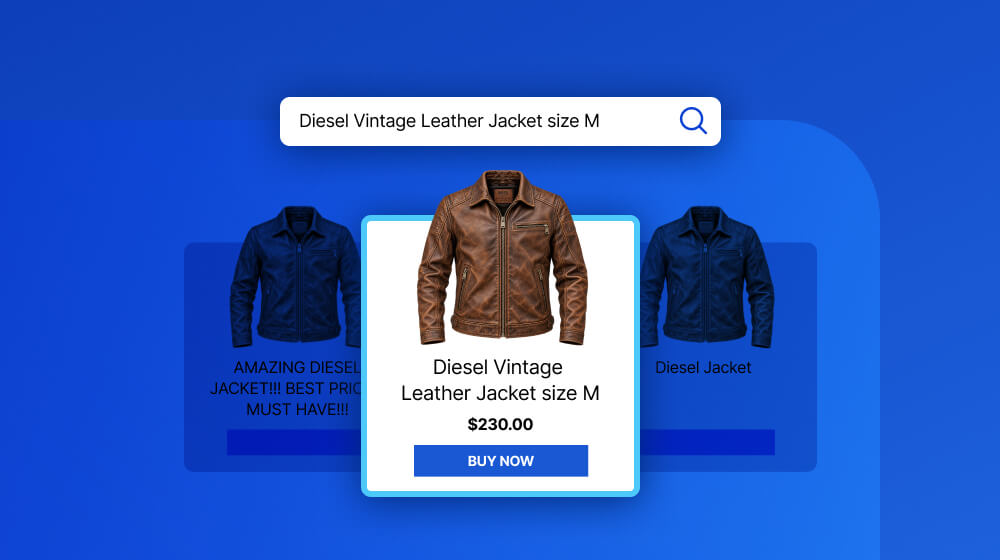
The process of optimizing a listing for eBay’s Cassini starts with understanding which keywords are best suited to a specific product and strategically placing them in the listing’s title and description.
Hence, front-loading the relevant keywords in the listing’s title, keeping the title under 80 characters, and using them contextually throughout the description.
Keep in mind that repeating the keyword too often is considered a black-hat SEO technique that can reduce the visibility of fixed-price listings, so be mindful of keyword density when creating or updating listings.
Moreover, structuring text with bullet points to highlight the product’s key features and populating the Item Specifics section makes the content easily readable by the platform’s AI-powered answer engine.
Furthermore, different generative engine optimization (GEO) practices, such as populating Item Specifics fields or creating visual content that clearly and accurately depicts products, can significantly increase the listing’s visibility on the platform.
Failing to implement the best SEO and GEO practices can cause a 20% drop in search impressions and lead to a listing’s lackluster performance across eBay’s marketplaces.
Paid ad campaigns
The top-selling product categories, like Electronics or Collectibles, are highly saturated, which is why sellers often rely on the platform’s paid advertising options to secure the top spot in the search results and reach more buyers.
eBay currently offers three paid advertising programs that sellers can manage from their advertising dashboard in Seller Hub:
- General Strategy – A Cost-Per-Sale campaign that allows sellers to pay a set ad rate fee whenever a product is sold within 30 days from an ad click. General Strategy campaigns provide promotional placement across the platform, but don’t guarantee the number one spot in the search results.
- Priority Strategy – A standard Cost-Per-Click campaign that gives sellers access to advanced keyword targeting tools and placement at the top of the search results. However, sellers pay for each click, even if one customer clicks the ad and another purchases the same item within the 30 days.
- Promoted Offsite – This Cost-Per-Click program enables sellers to drive traffic to their stores from external sources, such as the Google Ads network.
Launching a successful new campaign on eBay is a balancing act between content and listing quality, the bidding strategy, and the seller’s ad budget.
Only Priority campaign strategies support video content within the Promoted Listings ecosystem, so sellers cannot promote listings containing product videos through eBay’s other paid advertising programs.
Consequently, your content creation strategy for your sponsored listings must be adjusted to the type of paid advertising campaign you’d like to run.
Social media
Social commerce has been gaining momentum over the last few years.
A strong presence on Instagram, TikTok, Pinterest, or Facebook allows sellers to expand their listings’ reach, increase organic traffic, build brand awareness, and create a loyal customer base.
Still, the impact social media can have on your digital marketing strategy depends on your primary niche, since finding active social media communities is much easier for sellers in the Collectibles category than it is for merchants who primarily offer household items.
eBay’s social sharing tools are easily accessible from the Sellers Hub, so sellers can quickly share single or multiple product listings on their connected social media accounts.
In addition, eBay has recently joined Meta’s affiliate program, tailored for sellers looking to collaborate with content creators.
The program enables creators to embed eBay links in their Reels photos and text posts and earn a commission whenever their followers purchase via the affiliate link featured in their post.
Even though statistics show that only 3% to 5% of eBay’s overall traffic comes from social media, frequent listing sharing makes it more likely that shoppers will purchase a product they saw on social media via direct search on the platform.
Choosing the right digital marketing strategy for your eBay store

Whether you are just starting or you’re already an established seller, the primary goal of your digital marketing strategy should be to support your business goals.
If your goal is to grow a loyal customer base in a specific product category on your domestic eBay market, your advertising strategy should put your product in front of the right audience and help turn them into repeat customers.
On the other hand, if you have a vast portfolio spanning several categories, a set-it-and-forget-it approach to paid advertising can help improve platform-wide visibility.
Hence, before choosing the Priority or General Strategy program, you should first define your primary market, target audience, and sales goals.
Assess your eBay marketing needs
Keeping track of all performance metrics gives you insight into the areas of your eBay operations where you can improve.
Auditing your portfolio and reviewing its overall performance can help you identify items that need additional SEO or GEO, or that could benefit from CPC or CPS campaigns.
Focusing your digital advertising strategy on the underperforming areas of your business will help you address the issues that have prevented its growth and potentially expand it.
In addition, instead of focusing your advertising efforts on a single promotional channel, you should aim to create an omnichannel approach tailored to your business needs.
Pick the paid advertising model that aligns with your sales goals
Promoting your listings through Priority or General strategy programs can increase their sales velocity up to 50%. Still, the increase in revenue also raises sellers’ costs as eBay charges ad fees for each transaction.
That’s why, before adding a listing to a CPC or CPS campaign, sellers should first evaluate its baseline and suggested ad rates, as increased visibility could result in higher ad costs and consequently eat into their profits.
Furthermore, focusing on paid traffic that attracts casual browsers rather than high-intent buyers, while neglecting organic traffic, can be a costly mistake, since organic traffic traditionally yields higher conversion rates.
Creating a custom advertising strategy for your eBay listings
Creating an advertising strategy that supports your business’s growth takes time, careful campaign performance monitoring, and frequent iteration.
So, your SEO and GEO strategy should focus on organic listings growth by creating and structuring content for eBay’s search engine, while ensuring each listing contains primary keywords that perfectly match buyer intent.
On the other hand, allocating ad budgets and aligning campaigns with major seasonal online sales events like Black Friday are major factors in a campaign’s overall success.
eBay also offers a broad range of promotional tools that allow sellers to incentivize buyers with limited-time discounts, multi-buy product bundles, or seasonal sales promotions.
A hyper-focused approach leveraging organic traffic and targeted Priority CPC campaigns is best suited for niche sellers focusing on one or two distinct product categories.
Conversely, a broader, automated portfolio approach that uses General Strategy and Promoted Offsite campaigns performs significantly better for macro-sellers managing a vast inventory across a wide range of categories.
Using a digital marketing strategy to boost sales on eBay
Keeping track of the metrics allows sellers to see how well their marketing strategy is performing and to implement improvements based on real-time data.
Frequent iterations enable sellers to realign their approach with their sales targets, react quickly to marketplace fluctuations, and gradually increase their ROI.
Balanced omni-channel strategies usually deliver the best results regardless of the seller’s primary niche, as they improve the listings’ reach while delivering a blend of high-intent buyers and window shoppers.
Are you looking for a more efficient way to increase your store’s visibility across eBay’s international marketplaces? Schedule a call to learn how Webinterpret’s eBay listing tool can help you automate and scale your promotional efforts on eBay.
About Webinterpret
Webinterpret supports merchants selling on eBay.
Our AI-based solutions enable more effective selling through automated listing localisation, optimisation, advertising, and returns, and ensure all products placed on EU markets are GPSR-compliant.
By giving your international and domestic customers a full, end-to-end local shopping experience, Webinterpret improves your conversion rates and helps establish your business locally and globally.