
Every word you add to a product listing matters because it occupies space.
eBay limits the maximum number of characters sellers can use in a new product listing’s title and description.
That’s the reason your listing titles cannot exceed 80 characters, while the recommended product description length is approximately 4,000 characters, including spaces.
Furthermore, on mobile devices, product descriptions can’t be longer than 800 characters with spaces, or roughly 120 to 200 words, so your customers may not be able to find important information if you exceed this limit.
Sellers often use acronyms, like Excellent Used Condition (EUC), to save space and establish trust early in the purchase process.
Implementing this and similar tags effectively requires attention to detail, as using an acronym that doesn’t accurately describe a product’s condition can negatively impact sellers’ return rates, sales, and marketplace reputation.
Let’s see how you can use Excellent Used Condition and other acronyms to attract buyers to your eBay store.
Key takeaways
- Excellent Used Condition isn’t an official clickable tag sellers can select in eBay’s interface, but it is one of the most widely accepted seller shorthand on the platform.
- Placing the item condition tag at the end of a listing title allows sellers to front-load the keywords while communicating the product’s condition to consumers up front.
- 11% of shoppers on online marketplaces return products because the item they received didn’t match its description.
- The EUC tag’s meaning varies from one product category to another, so sellers must check the category rules before using the tag in a listing.
- Ripped, stretched, or stained items don’t qualify for the EUC tag.
What does the EUC acronym stand for?

The EUC is among the most used item condition acronyms on eBay.
It stands for Excellent Used Condition and describes pre-owned or refurbished products. However, it isn’t a formal item condition tag, so sellers must use it in combination with eBay’s official condition tags in the Item Specifics section, such as Refurbished, Used, or Like New.
Unlike Certified Refurbished or Used, the EUC cannot be used as an official condition grade for non-new products.
Even so, merchants frequently utilize EUC as a complementary condition tag in listing titles and descriptions to indicate to buyers that the product shows minimal or no signs of use.
Adding this condition tag to a product listing without prior verification of the item’s actual condition can trigger INAD or SNAD returns and gradually erode shoppers’ trust in sellers’ offers.
Excellent Used Condition requirements for pre-owned items
Before using the EUC tag to describe a product’s condition, you should make sure that it meets the following criteria:
- The product isn’t brand new, but it was barely used. The item is in perfect condition, even though it was used several times.
- No functionality issues – All features function as expected for the item’s age and product category.
- No visible wear – The product is not damaged or flawed and has been properly cared for by its previous owner, although it may contain blemishes.
It is important to remember that item condition assessment is often subjective, as most sellers use the requirements we mentioned above as guidelines rather than as the strict criteria each EUC item must meet.
The most used item condition tags on eBay

Understanding the differences between item condition tags, such as New, Like New, EUC, or Good Used Condition, is paramount for recommerce businesses because it enables them to provide shoppers with an accurate assessment of a product’s condition.
It’s also worth noting that eBay offers multiple Refurbished condition tags, such as Certified Refurbished and Seller Refurbished, but these tags are only available to qualified sellers in specific categories.
Let’s go through some of the most frequently used product condition tags on eBay.
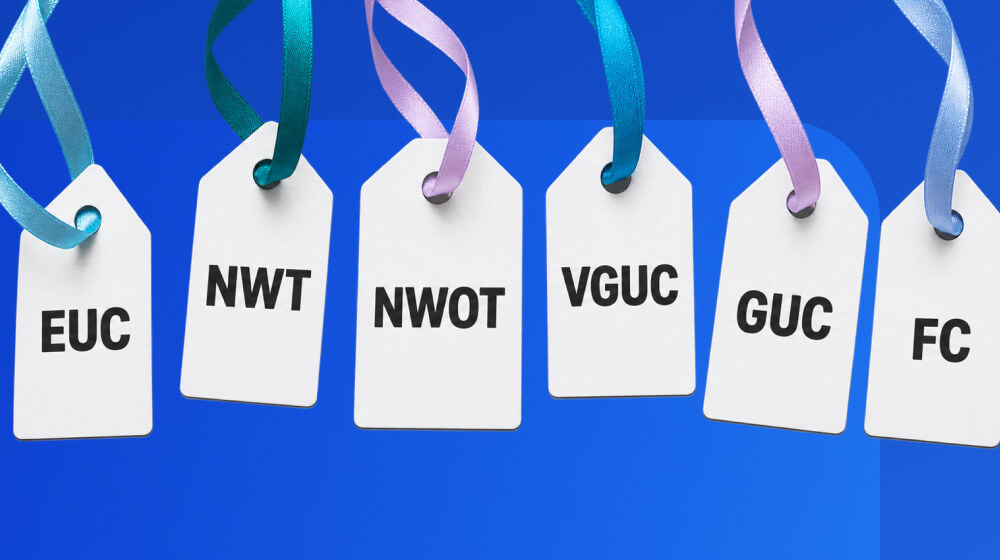
New with tags (NWT)
Most recommerce businesses rarely use the NWT acronym because it indicates that the product hasn’t been used.
The new with tags item condition is commonly used in the Fashion category to indicate that a product is brand new, unworn, and still retains manufacturer or store tags.
New without tags (NWOT)
This condition tag is used to describe products that are unused but no longer have their original paper tags.
NWOT tag isn’t suitable for all product categories, so sellers in the Electronics category must use Open Box or New Other tags to describe items that are no longer in their original packaging.
Clothes, shoes, jewelry, and watches are among the most common products with this condition tag, as it indicates that the item is a returned gift or lacks exterior retail tags.
Very good used condition (VGUC)
Like the EUC, VGUC isn’t a primary condition tag that recommerce businesses use to indicate that a product shows signs of wear, but it still means the product is in perfect working condition.
Sellers usually add this acronym to listings of media, collectibles, and electronics products with the platform’s official Pre-owned good condition tag.
Good used condition (GUC)
GUC is eBay seller shorthand for products that show noticeable signs of wear but still function flawlessly.
Make sure to document and disclose any scratches, rips, or discoloration in product descriptions of listings with the good used condition tag.
Fair condition (FC)
Collectible items with noticeable flaws are often labeled with Fair condition tags to indicate they are still usable or displayable, even though they are worn out.
Checking the item requirements for the EUC tag

Carefully inspecting each non-new item is necessary to determine its condition and the appropriate tag.
Adding the EUC tag to a listing of an item that is noticeably worn out can lead to returns, buyer disputes, and lower sales.
So, if an item has an odor, is missing some parts, or has a scratched screen, then VGUC or GUC tags are safer options than EUC.
Only items with minor blemishes warrant the use of the EUC tag, but sellers must ensure the listing includes images showing any marks or signs of wear.
Merchants examining products in the Electronics and Home & Garden categories should verify that the item functions properly and remains in its original packaging before applying the EUC tag.
Most importantly, sellers should remember that the EUC isn’t the official item condition tag on eBay, and that the best way to use it is to pair it with tags like Pre-owned Excellent or Like New.
Using the EUC tag in different product categories
The meaning of the EUC varies slightly by product category, so, for example, fashion sellers can use it to indicate that an item has vibrant colors or no loose threads.
On the other hand, adding this tag to a listing of an electronics product suggests that its performance and cosmetic condition are as good as new, but it doesn’t necessarily mean that the product is unopened.
So, before including this tag in a listing title or description, you should check the category benchmarks for used products in excellent condition.
Furthermore, products with any signs of structural damage or malfunctioning parts don’t meet the EUC requirements regardless of their category.
Understanding what the EUC acronym means across different product categories will help you apply it more accurately and prevent misunderstandings.
Still, recommerce businesses experience high INAD and SNAD return rates because EUC, Pre-Owned Excellent, or GUC tags are open to interpretation, and buyers often cite the item’s condition as the reason for returning a product.
Hence, misattributing the EUC tag to a product in your niche can increase your return rates and undermine your seller reputation on the platform.
How to use EUC and other item condition tags in eBay listing titles and product descriptions
In addition to a rigorous verification process, sellers must also choose where to place the EUC tag in listing titles and product descriptions.
Using the acronym at the beginning of the listing title can make it harder for buyers to instantly recognize whether an offer matches their search criteria.
Furthermore, eBay limits the length of listing titles on mobile devices to approximately 50 characters, so placing an item condition tag at the beginning of the title may make it harder for shoppers to determine what the item is without clicking it.
Conversely, placing the EUC within the first 60 to 80 characters of the product description maximizes its visibility on all devices.
It’s paramount to clearly define what the EUC tag means for a specific product by adding a detailed overview of the item’s blemishes, if any, to the description.
Defining what constitutes excellent condition is also paramount, as it reassures potential buyers that the product is in mint condition and helps them make purchasing decisions faster.
Building trust and growing sales on eBay with EUC and other item condition acronyms
The recommerce market will continue to grow rapidly over the next five years, with its value expected to increase from $236 billion in 2026 to $354 billion in 2032.
As demand for used products increases, product categories like Home & Garden and Fashion, which commonly feature pre-owned items, are likely to become more competitive.
The EUC and other item condition tags can give sellers in eBay’s focus categories a competitive advantage by improving listing SEO and serving as a trust signal for potential buyers.
Still, it’s vital to use item condition tags cautiously to avoid SNAD and INAD returns caused by discrepancies between the product’s description and its actual condition.
Webinterpret helps recommerce businesses in Electronics, Collectibles, Fashion, and other eBay focus categories expand internationally. Schedule a call to learn more about our services.
About Webinterpret
Webinterpret supports merchants selling on eBay.
Our AI-based solutions enable more effective selling through automated listing localisation, optimisation, advertising, and returns, and ensure all products placed on EU markets are GPSR-compliant.
By giving your international and domestic customers a full, end-to-end local shopping experience, Webinterpret improves your conversion rates and helps establish your business locally and globally.